
Trying to chase a late payment from a customer you want to keep is awkward. You finish the job, they are happy, and they pay part of it. Then the rest just sits. A week goes by. Then three. You do not want to be the person who nags, and they have not said anything, so nobody says anything. Meanwhile it is your money and your cash flow, and it is starting to bother you more than you will admit.
If you are trying to chase a late payment without wrecking the relationship, the first thing to know is that most late balances are not refusals. Someone who plans to stiff you usually does not pay the first part. Someone who pays part and then goes quiet is usually busy, embarrassed or disorganized. That matters, because it changes how you should write to them.
Why the balance goes quiet
It is the same stalled decision I described in why customers go quiet after a quote, just at the other end of the job. Paying is a small task that no one is forcing them to do today. It goes on the pile with every other small task, and a task with no date on it does not get done.
There is a second reason that is less comfortable. Sometimes they are short on cash and ashamed to say so, so they say nothing. If that is the case, silence is not defiance, it is avoidance, and a message that makes it easy to answer honestly will do better than one that makes them feel cornered.
Before it is late: make it easy to pay
Most of the work happens before the due date. Three habits cost nothing:
- Send the invoice the day the work is done, not a week later when you remember.
- Put the amount, the due date and a way to pay on the same page. If they have to hunt for how to pay, they will not.
- Agree the terms in writing before the job starts, including what a deposit and a balance look like. The written price sheet from quoting jobs faster is a natural place to put them. A balance that was never explicitly agreed is a balance that is easy to dispute.
I am not a lawyer and I am not going to give you legal advice about what you can enforce. What I can say from the business side is that a clear written agreement makes every message below easier to send, because you are reminding them of something they already said yes to.
The first message: the day after it is due
Keep it short, factual and warm. No apology, no accusation.
"Hi, just a quick note that the balance on the invoice from the job at your place was due yesterday. Here is the amount and the link to pay it. Let me know if anything is holding it up."
That last line does real work. It gives them an easy way to answer with a reason instead of silence. Notice that it does not say "just checking you got my invoice," which, as I wrote about quotes, hands the same piece of homework back and asks them to do the thing they have been avoiding.
The second message: a specific ask, a week later
If nothing came back, the second message adds something new. Do not repeat the first one.
"Hi, following up on the balance from the job. Could you get it to me by Friday? If that does not work for you, tell me what would, and we can set up a short plan so it is not all at once."
Offering a short payment plan is not weakness. For someone who is short on cash, it is the thing that lets them say yes. For someone who is only disorganized, the Friday date is what they were missing.
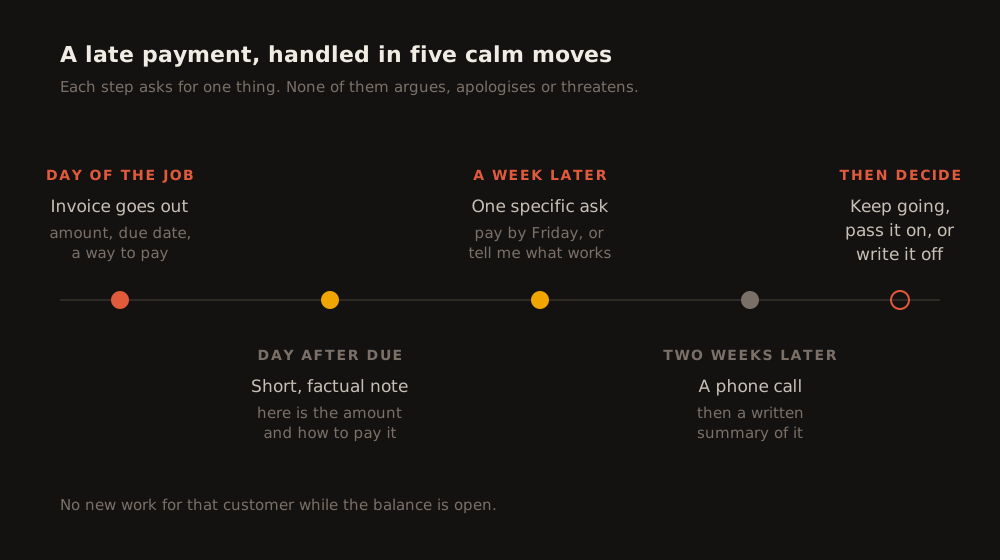
The third step: pick up the phone
If two messages have gone unanswered, stop writing. A call is harder to ignore and easier to be human on. Say what you are calling about, ask what is going on, and listen. Then follow the call with a short written note summarizing what you both agreed, including any date.
That written summary is the thing most people skip, and it is the thing that turns a friendly promise into a record.
A late payment is a stalled decision. Your job is to make the next step small, specific and easy to say yes to.
What not to do
There are a few things I would avoid, and they are mostly about keeping your head:
- Do not shame them or write in all caps. It feels good for about a minute.
- Do not threaten things you are not prepared to do.
- Do not complain about them online or to mutual contacts. It rarely helps and it can hurt you.
- Do not keep doing more work for them while a balance is open. Finishing a second job for someone who has not paid for the first one just makes the number bigger.
When to stop chasing
At some point you have to decide whether to keep going, hand it to someone else, or write it off. That is a business decision, not a moral one, and it depends on the size of the balance and what it costs you to pursue it. If the amount is significant, talk to a lawyer or look up your local small-claims process rather than taking my word or anyone else's on what you can do.
What I will say is that deciding in advance, before you are angry, is better than deciding in the middle of it.
Where this runs on memory, and what to do about it
Look at the sequence again. Invoice on the day, a note the day after it is due, a specific ask a week later, a call at two weeks. None of it is hard. All of it needs someone to remember the date. That is where it breaks, for the same reason follow-ups on quotes break: the whole thing runs on your memory, and your memory is busy on the next job.
The fix is a clock, not a technique. A calendar entry or a saved set of messages that fires on the due date will do it. If you want help setting that up so it stops depending on you, ask for a free audit and I will look at where your balances slip first.