
Most owners who want to quote jobs faster assume the problem is time. They are busy, quotes are slow, so they need more hours. I do not think that is the real problem. Sit with a stack of unanswered requests and you find that almost none of them are hard. They are just different from each other, and every one of them gets worked out from zero.
A fence is priced by the foot, plus gates, plus whatever is in the way. A roof depends on pitch and layers. A sign, a shirt run, a pressure wash, a paint job: the price moves with size, options and how soon they want it. So each request becomes a small puzzle, and small puzzles get put off until the evening, when you are tired and the customer has already asked someone else.
Why every quote starts from zero
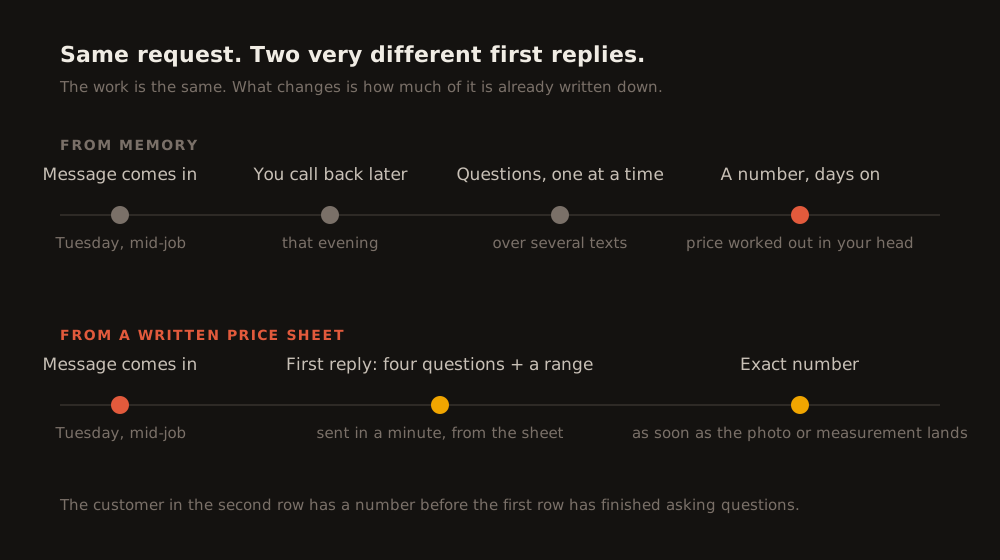
When the rules for pricing only exist in your head, nobody else can apply them, and you cannot apply them quickly either. You have to stop what you are doing, pull the numbers back up, remember what you charged the last similar job, and then argue with yourself about whether this customer is a bigger job than they sound.
That is slow, but the slowness is not the worst part. The worst part is that the customer is waiting through all of it. As I wrote in why customers go quiet after a quote, the person asking for a price is usually asking two or three people the same week. The one who comes back with a real number first has done most of the selling before anyone talks about quality.
Write the rules down once
This is the whole trick, and it is less glamorous than it sounds. Take an hour, one time, and write down how you actually price. Not how a textbook says to price. How you do it.
For most small businesses the sheet has the same few lines:
- A base price for the standard version of the job.
- The thing that scales the price: per foot, per square, per piece, per hour.
- The add-ons people ask for, each with its own number.
- A minimum, so the small jobs are not a loss.
- What rush, travel or difficult access adds.
It does not need to be pretty. A page of notes is fine. What matters is that when a request comes in, the rules are already written, so applying them takes a minute instead of an evening. If you ever hand quoting to somebody else, the sheet is also what makes that possible.
I will say plainly that I am not going to give you the numbers to put on it. I do not know your costs or your market, and any figure I printed would be a guess dressed up as advice.
Four questions that cover most jobs
The sheet tells you how to price. The intake tells you what to price. The mistake I see most often is a long back-and-forth, one question at a time, spread over a day. People do not answer the fourth text.
Ask them all at once, in the first reply, and keep it to four:
- What is the job, in a sentence?
- How big is it, roughly? A rough size is enough to start.
- When do they need it?
- Where is it? The address or at least the neighborhood.
Add one fifth ask for a photo if the job is visual. A photo answers three questions you did not have to ask. These four questions are the same ones a good short form on your website would ask, which is why putting them on the page works so well: the customer answers them while they are still motivated.
Send a range now, an exact number after
Here is where owners get stuck. They think a quote has to be exact, so they cannot send anything until they know everything. But a customer in the early stage does not need an exact number. They need to know whether you are in the neighborhood of what they expected.
So the first reply carries a range, built from the sheet and the rough size. Something like: "For a job like that we are typically between this and this, and I can give you an exact number once I see a photo or measure it." Then you send the exact number when the photo lands.
I want to be careful here, because a range can go wrong. Do not make it so wide that it means nothing, and do not give a range you would not honor at the low end. A range is a promise about where the price will land. If you cannot stand behind the bottom of it, narrow it.
A customer with a range in hand is already a customer with a decision to make. A customer waiting on an exact number has nothing to decide yet.
Put a date on it
Once you have the number, the same rule from the quote follow-up applies: attach two real start dates and one question that can be answered in a few words. The price and the dates travel together. That small habit is the difference between a quote that sits in someone's phone and one that gets a reply.
Where software can help, and where it cannot
Once the sheet exists, parts of this can be automated. A form or chat on your site can ask the four questions, apply your rules and hand you a draft quote to approve, so the first reply goes out while you are still on the roof. That is most of what I build for local businesses, and it is the kind of contact step that captures the job details up front.
But I want to be honest about the order. The sheet comes first. A tool sitting on top of a vague price list does not make quotes faster, it makes wrong quotes faster. If you cannot write your pricing rules down in a page, automating them will not fix that, and I would rather tell you so than sell you the tool.
After the job: getting paid
The same habit carries through to the end. Write down how you handle a balance that comes in late, the same way you wrote down your prices, and the awkward conversation becomes a routine one. I cover that in how to chase a late payment without losing the customer, and it starts before the invoice goes out.