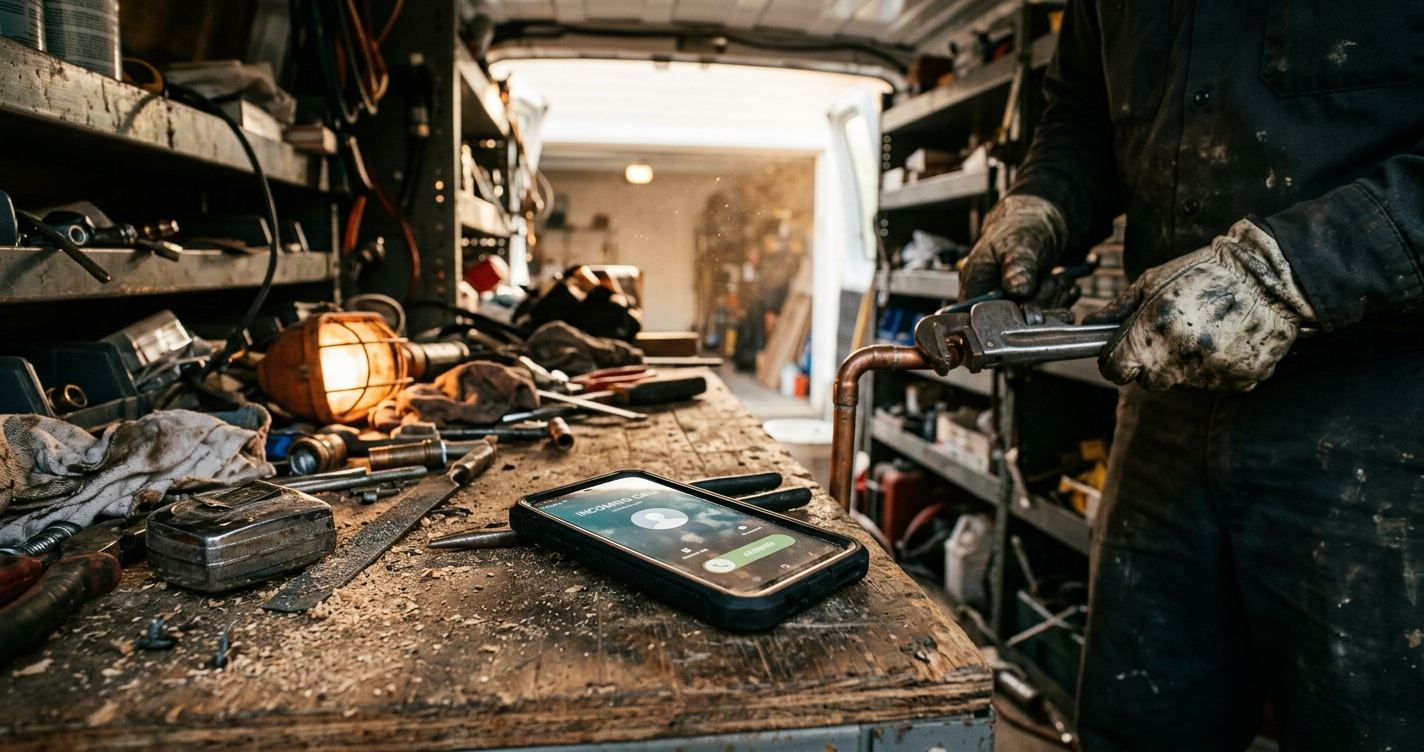
You drove out to a house in Metairie on a Tuesday. Walked the job, took the measurements, listened to what they actually wanted rather than what they first asked for. They were friendly. They said they wanted to get moving on it. You spent Tuesday evening working the numbers properly instead of watching the game, sent it Wednesday morning, and then nothing.
Thursday, nothing. Friday you send a short message asking if they got it. Nothing. The following week you drive past on the way to another job and somebody else's van is in the driveway.
The question every owner asks at this point is was I too expensive. It is almost always the wrong question, and you can tell it is the wrong question from the timing alone.
The decision was over before you started waiting
Someone asking you for a price is almost never asking only you. They have two or three others coming out the same week. That part you probably know. Around New Orleans, where there are half a dozen decent trades within a twenty-minute drive of any address, that is simply how it goes. The part that catches people out is what those two or three are actually being compared on, because it is not the number.
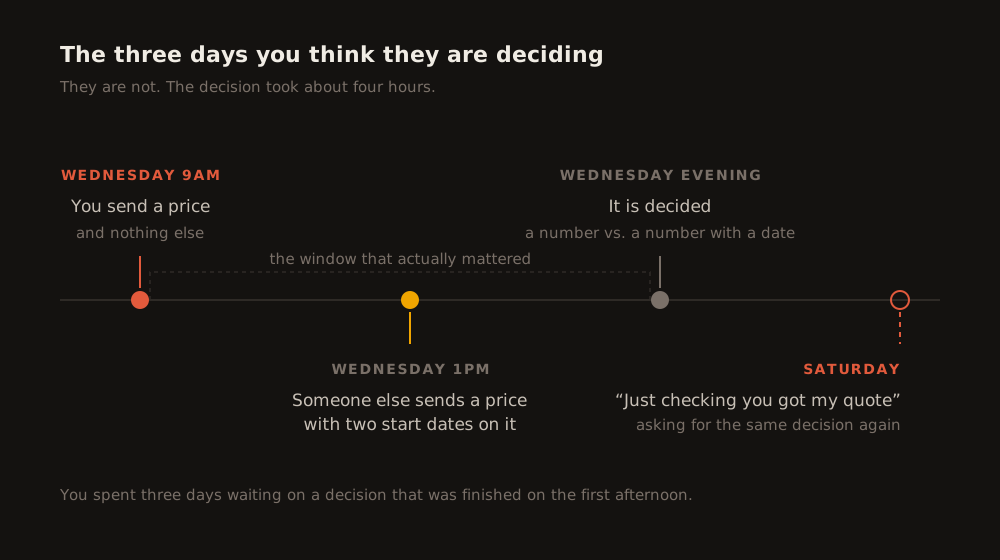
By the time three quotes are sitting in someone's phone, the prices are usually close enough that none of them settles it. What settles it is which one felt like less of a decision. Which one had a date attached. Which one answered the question they were really asking, which was never how much — it was when can this be over with.
A price on its own is homework. Whoever removes the homework wins the job.
A quote with nothing else on it says: here is a number, now you go and work out what happens next. That is a task. It goes on the pile with the other tasks. A quote that says here is the number, I could start Thursday or the Monday after, which suits you is not a task. It is a question with two answers, and both of them are yes.
What silence actually means
Here is the useful distinction, and it took me a while to see it. People who think your price is too high usually tell you. Not always kindly, but they tell you, or they ask whether you could take something out, or they mention what the other guy said. A price objection makes noise.
Total silence is a different animal. Total silence usually means the decision never got made at all. The job stopped feeling urgent. Something else came up that week. They opened the quote, felt the size of the number, put the phone down to think about it, and then simply never picked the thought back up.
That matters because it changes what you are dealing with. You are not competing against a cheaper quote. You are competing against the job never happening. And a stalled decision does not stay stalled forever — it eventually goes to whoever gives it a nudge that is easy to respond to.
Why “just checking in” makes it worse
The standard follow-up is some version of just checking you got my quote. It feels polite, which is why everyone sends it. It also does the one thing you cannot afford to do twice: it hands the same piece of homework back.
Think about what it asks for. It asks them to go back, find the quote, re-read it, make the decision they already avoided making once, and then compose a reply about it. That is more work than ignoring you. So they ignore you, and now ignoring you has become a small habit.
It is also, if you read it honestly, a message about you. It is you asking for reassurance. Nothing in it is any use to the person receiving it.
Send a next step, not just a number
The fix is smaller than it sounds and it is not a sales technique. Every quote that leaves gets two things attached to it before you hit send.
Two dates you could actually start. Real ones. This turns an open-ended commitment into a calendar item, and it quietly tells them that your availability is a real thing that moves, without you having to say anything that sounds like pressure.
One question answerable in four words. Would Thursday or the Monday after suit you better? That can be answered at a red light. Let me know your thoughts cannot be answered at all without sitting down first, which is why it never is.
Then, when you do follow up, the rule is that each message carries something the last one did not. A slot that is about to go. A photo from a job like theirs. A note that the price holds through the end of the month. Anything other than a repeat. A follow-up that only repeats the previous one teaches the other person that ignoring you costs nothing.
I am deliberately not going to tell you how many times to follow up, or quote you a statistic about it. I have seen the numbers that get passed around online and I cannot source most of them, and I am not going to put a figure on your business that I cannot stand behind. What I can tell you is the shape: new information each time, and an easy way to answer.
The part that actually breaks
None of the above is hard. That is precisely why it does not happen. It does not happen because the whole thing currently runs on memory, and memory is busy driving to the next job.
A quote leaves on Wednesday with every intention of being followed up on Friday. Friday is a mess. By Monday the quote has slid far enough down the thread that it is out of sight, and out of sight is where quotes go to die. Nobody decided to drop it. There was just never anything holding it.
So the actual fix is a clock, not a technique. The moment a quote goes out, something other than your brain needs to be holding the date you will chase it. A calendar entry with the customer's name in it will do. A saved message template with the two-dates line already written will do. The point is only that it survives a bad week.
This is the same failure mode I wrote about in why your phone ringing is not the same as getting leads — the lead is real, the work is real, and the gap is a small mechanical one between the interest and the booking. That gap is where most of a New Orleans trade business's lost revenue actually sits, and it is nearly always cheaper to close than it is to go and find more leads to pour into the same leaky bucket.
If you want to see what that looks like built into a site rather than held in your head — a contact step that captures the job details up front, so your quote can carry a date on it the first time — that is most of what we do on websites for trades.