There is a particular kind of disappointment that only happens once. You finally get the listing set up. For weeks, nothing. Then the phone goes, and it is a real person with a real job, and for about four seconds it is the best thing that has happened to the business all month.
Then you ask where they are and it is a town you have never driven to, several hours away, for a job worth less than the fuel.
Then it happens again. And the conclusion almost everyone draws is that Google sends junk, or that the whole thing does not work for a business like theirs. It is the wrong conclusion, and the real one is more annoying, because it means the calls you wanted were never going to arrive while the settings looked like that.
Two circles that people think are one circle
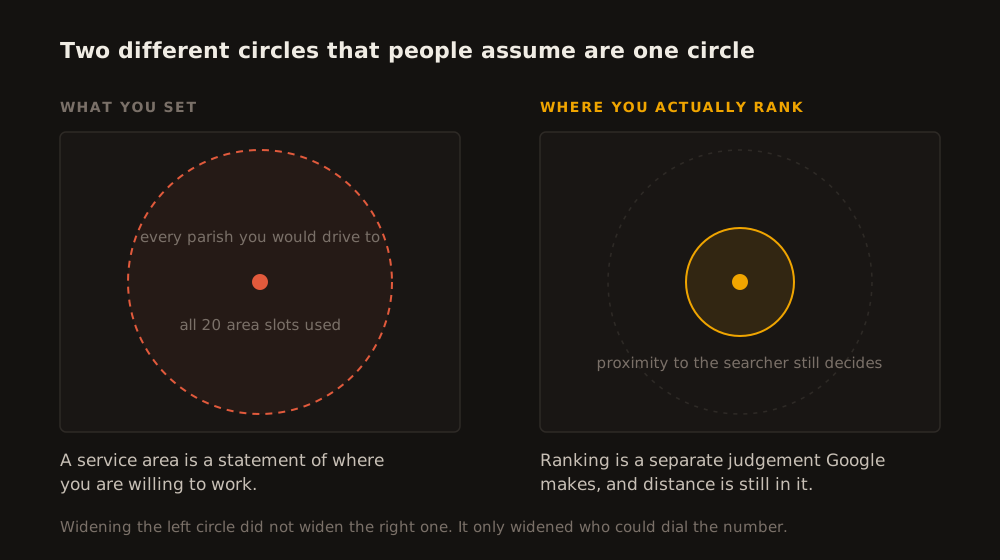
The mistake sits on a single assumption: that the service area you type in is the area you will show up in. It reads that way. It is not what it does.
Your service area tells Google where you are willing to travel. Where you actually appear in results is a separate judgement, and Google is explicit in its own documentation that setting a service area does not mean you will rank in that area's searches. Ranking gets decided on relevance, distance and prominence — and distance means how close you are to the person doing the searching, not how far you said you would drive.
Widening the area you serve does not widen the area you rank in. It only widens who can dial the number.
Why a wide area actively costs you
If it only did nothing, it would be harmless. It does slightly worse than nothing.
A profile claiming to serve half the state is telling Google it is not especially a New Orleans business, or a Metairie business, or a Chalmette business — it is vaguely a Louisiana business. Relevance to any one place gets thinner as the claim gets broader. The trades I see winning the map results in a given neighbourhood are almost always the ones whose profile, reviews and site all point hard at that neighbourhood, not the ones claiming the widest coverage.
Meanwhile the calls that do come through are the worst kind of noise, because they feel like progress. You answer them, you quote them, you spend an evening on a job two parishes away that was never going to close, and the whole time the actual problem — that you are invisible three streets from your own house — goes unexamined because the phone is technically ringing.
What to actually set
First, the thing that trips people up: you cannot set a radius any more. The old drag-a-circle-on-a-map control is gone. Service areas are now named places — cities, parishes, regions or postal codes — and you can list up to twenty of them.
Google's guidance is that the whole area should not stretch more than about two hours of driving from where you are based. That is the ceiling, not the target. The better test is simpler: list the places you would genuinely turn out for on an ordinary Tuesday, for an ordinary job, without having to think about whether it was worth it.
For most of the one-van operations I talk to around New Orleans, that is between three and six areas. Not twenty. There is no bonus for filling the slots, and every area you add that you would not really drive to dilutes the ones you would.
One more thing worth checking while you are in there: if you work from a yard or a shop that customers never visit, your address should be hidden rather than listed. A service-area business that displays a residential address is a common reason for a profile getting flagged, and it is a two-click fix.
The other version of this problem: you changed your name
There is a second way a profile ends up misconfigured, and it looks nothing like the first until you realise it has the same root.
The business changes name. New trading name, a partner leaves, the DBA gets updated. And the instinct is to go and create a fresh listing under the new name, because the old one says the old thing.
Do not do that. A new listing starts at zero — no reviews, no photos, no history, none of the prominence you spent two years earning. Worse, you now have two listings for one business, which is against Google's rules and is a good way to get one of them suspended, sometimes the wrong one.
The correct move is to rename the profile you already have. Edit the name on the existing listing. It may sit in review for a while before the change shows, and that wait is uncomfortable, but it keeps every review attached to the business that earned them. Then update the name everywhere else it appears — your site, your invoices, your directory listings — so the details match. Mismatched business details across the web are their own slow drag on local ranking.
How to tell which one you have got
Pull up your profile on a phone and check three things. What areas are listed, and would you drive to all of them tomorrow. Whether your address is showing when it should not be. And whether the name on the listing matches the name on your invoices exactly, character for character.
If the calls you are getting are from the wrong places, it is almost always the first one. If you are getting nothing at all, it is more likely the profile is simply not finished — which is a different problem, and the one I wrote about in why your business is not showing up when the profile looks abandoned.
And if the honest answer is that you are not sure anyone is searching for you in the first place, start with why the posting you are already doing is not producing calls, because the fix there comes before this one.
If you would rather have someone go through the settings properly than guess at them, that is exactly what our Google Business Profile work covers.