I've been spending my afternoons calling and Googling home service businesses around New Orleans, and somewhere in that process I noticed something I wasn't even looking for. It has nothing to do with phones.
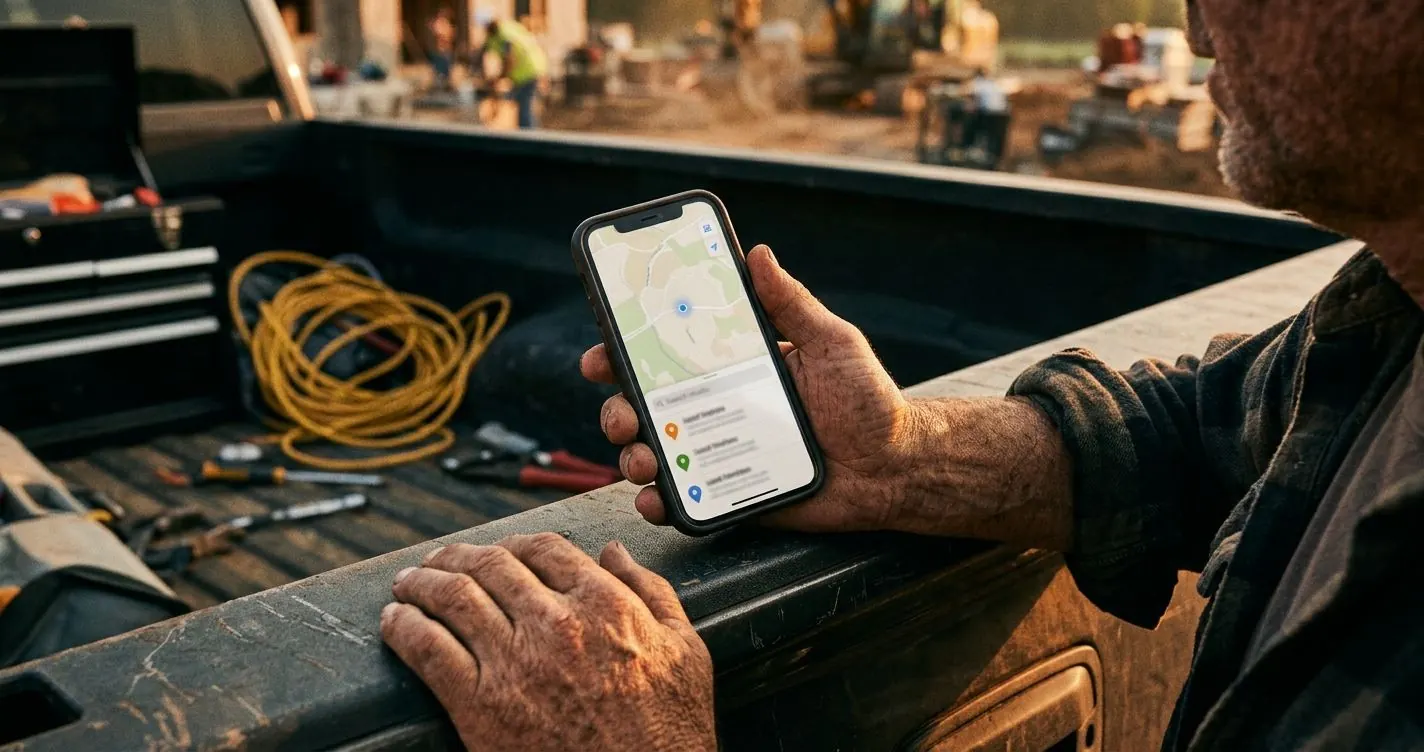
When I search "electrician new orleans" or "roofer marrero," Google shows me a map with three businesses pinned at the top before I ever see a single website. Click one of those three and there's the phone number, the hours, a stack of photos, forty reviews with the owner replying to half of them. Click the business right below it, the one that's actually a fine company doing fine work, and there's a gray placeholder photo, three reviews from 2020, and hours that say "Hours not provided."
Same trade. Same neighborhood. Probably the same quality of work. One of them gets found. The other one doesn't exist as far as most people searching are concerned.
The map pack decides who gets found before your website ever loads
When somebody searches for a service near them, Google doesn't lead with a list of websites anymore. It leads with three pinned businesses on a map, right at the top of the page, above everything else. That's called the map pack, and for a huge share of searches it's the only thing people look at. They tap one of the three pins, or they scroll past all of it entirely.
Here's what that means in practice. You could have the best-built, fastest-loading website in the city, and it won't matter if you're not one of those three pins, because most people never scroll down far enough to find out your website exists.
You could have the best-built website in the city, and it won't matter if you're not one of the three pins on the map.
I think a lot of business owners hear "we need a better website" and nod along, because a better website is a real thing and it does help. But if the map pack is where people are actually looking, and you're not in it, the website was never the bottleneck.
Google ranks profiles, not businesses
Google decides who shows up in that top three using roughly three things: how well your profile matches what somebody searched, how close you are to them, and what Google calls prominence, which is really just how established and well-documented your business looks online.
You don't control the first one much beyond picking the right category. You don't control the second one at all, that's just geography. But prominence is almost entirely in your hands, and it's built from things that take ten minutes and that most businesses never touch after the day they claimed the listing: how many reviews you have, how recent they are, whether you've filled in every field Google gives you, whether there are real photos, whether you post anything, whether questions sitting in your Q&A tab have answers.
Claiming a Google Business Profile and never going back to it is a lot like getting a phone number and never checking the voicemail. The listing exists. Nobody's actually running it.
What "not developed enough" looks like in practice
It's rarely one big thing missing. It's five small ones stacked up.
The category is set to something generic like "Contractor" instead of the specific trade, which matters because Google is matching your category against what people actually type. The service area is empty or only covers one zip code when the business really covers eight. The hours are wrong, or blank, which quietly tells anyone checking at 7pm that you might not even be open right now. The photos are four years old, or there are three of them, or they're stock images that could belong to any plumbing company in the country. Nothing's ever been posted. And there's a question sitting in the Q&A section, sometimes asked by a real customer, that's had no answer for over a year, visible to everyone who visits.
Individually none of these feel like a big deal. Together, they're the difference between a profile that looks like an active business and one that looks like it was set up once and forgotten.
Reviews are the one thing Google can't fake for you
Reviews get talked about like a popularity contest, and I don't think that's quite it. What Google actually seems to weigh is recency as much as volume.
A business with eight reviews, all from the last three months, regularly beats a business with sixty reviews where the most recent one is from 2021. That makes sense if you think about what Google's trying to figure out, which is whether you're still operating and still good right now, not three years ago. A pile of old reviews with nothing new coming in reads the same to Google as it does to a customer scrolling past it: this place used to be busy.
Responding to those reviews matters too, and not just the bad ones. A short reply, even just "thanks, glad we could help," shows there's a real person behind the profile checking in. Forty five-star reviews with zero replies from the owner has a strange, slightly hollow feeling to it if you actually read through them. It looks automated even when it isn't.
Asking for reviews feels awkward. Ask anyway.
I think this is the actual reason most profiles go stale, more than anyone forgetting. Asking a customer for a review feels like asking for a favor, and most tradespeople would rather just do good work and let it speak for itself.
The problem is it doesn't speak for itself if nobody's prompted to say anything. The businesses with steady, recent reviews aren't necessarily doing better work than the ones without. They've just made asking part of finishing the job.
The easiest version of this: text the customer a direct link the same day, while the job's fresh and they're still happy about it, rather than emailing them three weeks later when the memory's faded into "yeah it was fine." A direct link that drops them straight into the review box, not just your general profile page, is worth the extra minute it takes to set up, because every extra tap between "I'd leave a review" and actually leaving one loses people.
The bad review that never gets a response
Every business gets an unfair one eventually. What actually does damage isn't the review, it's the silence underneath it.
A one-star review from two years ago with no reply sitting at the top of your profile tells a stranger two things: something went wrong, and nobody cared enough to address it. Neither of those is necessarily true, but that's what the silence implies. A calm, short reply, even to a review you think is unreasonable, changes the story completely. Now it reads as "one bad day, handled professionally," which is a much easier thing for a new customer to look past.
Deleting or reporting a review should be a last resort for something that's actually fake or abusive. For everything else, answering it does more for you than making it disappear ever would.
What I'd do this week
Search your own business name from a phone that isn't logged into your Google account, so you're seeing what a stranger sees. Look at the category. Look at the hours. Count how many photos are there and how old they look.
Then fix what's fastest. Update the category if it's generic. Add real photos of actual jobs, not stock. Answer anything sitting unanswered in the Q&A tab. Reply to every review on the page you haven't replied to yet, even the old ones. And text the last five happy customers a direct review link today, while it's still on your mind.
None of that takes long, and unlike a lot of marketing advice, it's completely free.
This is part of the same thing I wrote about with missed calls: most of what's costing New Orleans trades work isn't a lack of demand, it's small, fixable gaps between somebody wanting to hire you and actually managing to find you or reach you. I'm folding a Google profile audit into the same call study I'm already running, so when it's done you'll be able to see exactly where you'd land next to everyone else in your trade.